

Operant Conditioning

Operant Conditioning is the term used by B.F. Skinner to describe the effects of the consequences of a particular behavior on the future occurrence of that behavior. There are four types of Operant Conditioning: Positive Reinforcement, Negative Reinforcement, Punishment, and Extinction. Both Positive and Negative Reinforcement strengthen behavior, while both Punishment and Extinction weaken behavior.
In Positive Reinforcement a particular behavior is strengthened by the consequence of experiencing a positive condition. For example:
A hungry rat presses a bar in its cage and receives food. The food is a positive condition for the hungry rat. The rat presses the bar again, and again receives food. The rat’s behavior of pressing the bar, is strengthened by the consequence of receiving food.
 A hungry rat presses a bar in its cage and receives food. The food is a positive condition for the hungry rat. The rat presses the bar again, and again receives food. The rat’s behavior of pressing the bar, is strengthened by the consequence of receiving food.
In Negative Reinforcement a particular behavior is strengthened by the consequence of stopping or avoiding a negative condition. For example:
 A rat is placed in a cage and immediately receives a mild electrical shock on its feet. The shock is a negative condition for the rat. The rat presses a bar and the shock stops. The rat receives another shock, presses the bar again, and again the shock stops. The rat’s behavior of pressing the bar, is strengthened by the consequence of stopping the shock.
In Punishment a particular behavior is weakened by the consequence of experiencing a negative condition. For example:
A rat presses a bar in its cage and receives a mild electrical shock on its feet. The shock is a negative condition for the rat. The rat presses the bar again and again receives a shock. The rat’s behavior of pressing the bar, is weakened by the consequence of receiving a shock.
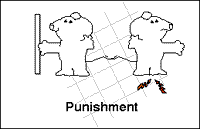
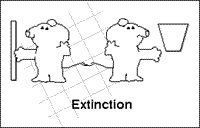
In Extinction a particular behavior is weakened by the consequence of not experiencing a positive condition or stopping a negative condition. For example:
A rat presses a bar in its cage and nothing happens. Neither a positive or a negative condition exists for the rat. The rat presses the bar again and again nothing happens. The rat’s behavior of pressing the bar, is weakened by the consequence of not experiencing anything positive or stopping anything negative.
More about the concept of Negative Reinforcement.
Here are two examples of Negative Reinforcement:
- A rat is placed in a cage and immediately receives a mild electrical shock on its feet. The shock is a negative condition for the rat. The rat presses a bar and the shock stops. The rat receives another shock, presses the bar again, and again the shock stops. The rat’s behavior of pressing the bar is strengthened by the consequence of the stopping of the shock.
- Driving in heavy traffic is a negative condition for most of us. You leave home earlier than usual one morning, and don’t run into heavy traffic. You leave home earlier again the next morning and again you avoid heavy traffic. Your behavior of leaving home earlier is strengthened by the consequence of the avoidance of heavy traffic.
|
The concept of Negative Reinforcement is difficult to teach and learn because of the word negative. Negative Reinforcement is often confused with Punishment. They are very different, however. Negative Reinforcement strengthens a behavior because a negative condition is stopped or avoided as a consequence of the behavior. Punishment, on the other hand, weakens a behavior because a negative condition is introduced or experienced as a consequence of the behavior. |
conditioning
2 comentarii
Mesajul tău...Anulează răspunsul
Acest site folosește Akismet pentru a reduce spamul. Află cum sunt procesate datele comentariilor tale.
Internet Sex Addiction Treated With Naltrexone
J. Michael Bostwick, MD and Jeffrey A. Bucci, MD
Influence of the endogenous opioid system on high alcohol consumption and genetic predisposition to alcoholism
Christina Gianoulakis
Douglas Hospital Research Centre and Department of Psychiatry, McGill University, Montreal, Que.
Reward Processing by the Opioid System in the Brain
Julie Le Merrer, Jérôme A. J. Becker, Katia Befort and Brigitte L. Kieffer
Reward Loss as Psychological Pain
Mauricio R. Papini*, Michael Wood, Alan M. Daniel, and Jacob N. Norris
Texas Christian University